


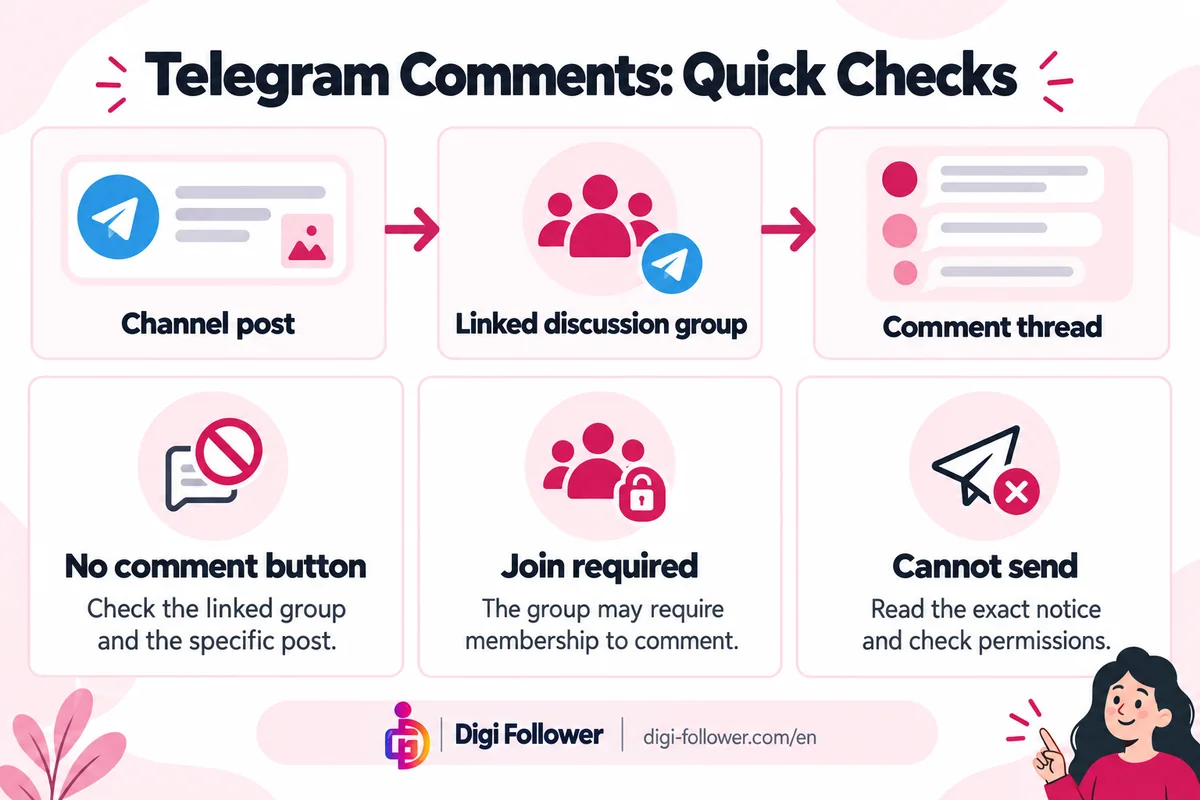
If readers cannot comment on a Telegram channel post, first identify what is missing: the comment button, access to the discussion, or permission to send a message. These are different problems. This guide gives channel owners and readers a practical way to narrow down the cause.
How a channel post connects to its comments
A channel can have a linked discussion group. Comments appear in a separate conversation for the post and also in that group. Telegram describes this arrangement in its Channels FAQ. A channel and its discussion group therefore serve different purposes: one carries the posts, while the other hosts the conversation.
Where owners can enable discussion
Telegram points channel owners to Channel Settings → Discussion to enable discussions. Open that section and review the group connected to your channel. The wording and layout can vary by app version. Telegram’s official introduction to channel comments explains the feature and this settings location.
After making an intentional change, test it with a normal new post and a reader account you control. Check both whether the comment button appears and whether the reader can actually send a reply. Record the result before changing another setting. This separates successful setup from a remaining access problem.
Start with one exact post
Keep the same post open while investigating. Record its link, the wording of any message on screen, and whether another recent post behaves differently. Comparing unrelated channels makes it harder to isolate a setting that belongs to just one channel.
| Symptom | First check | Next action |
|---|---|---|
| No comment button across recent posts | Whether the channel has a linked discussion group | Ask the channel owner to review the connection |
| Comments are missing on one post | The corresponding post in the discussion group | Ask an administrator to investigate that specific thread |
| A prompt asks you to join before commenting | The discussion group’s joining requirement | Follow the displayed joining process if you want to participate |
| The discussion opens but sending fails | The exact notice and your access | Share the notice with an administrator |
For owners: check the linked group and the affected thread
Review the discussion group associated with the channel. Then locate the affected post’s conversation. Telegram’s discussion documentation explains that a post’s comments are replies to its automatically forwarded message in the linked group. Removing that forwarded message disables the comment section for that post.
Do not delete messages as a diagnostic experiment. Instead, note what is present before changing anything. If a moderator recently changed the group or removed a post, include that fact in the investigation. It is useful evidence, but it does not by itself establish what happened.
For readers: a joining prompt can be intentional
Telegram supports a setting that requires people to join a discussion group before commenting. This is documented in its joining requirement reference. Being able to read a channel post is therefore not proof that you can immediately send a comment.
Read the prompt rather than submitting the same message repeatedly. If you cannot complete the displayed process, contact the group’s administrators. They need the specific post and notice to investigate; a general statement that Telegram comments are broken leaves several different possibilities open.
A short report that an administrator can use
Send the post link, approximate time, device or app used, and the exact message shown. Explain whether the button is absent, the thread will not open, or sending is refused. Include a comparison with one other post only if you actually tested it. Keep passwords and login codes out of the report.
Post link: [link]
Time and app: [details]
What I see: [exact notice or missing button]
What I tried: [steps]
Comparison: [another post, if tested]
Does this prove that the channel is restricted?
No. A missing button or failed submission is an observation, not a diagnosis. Check the group connection, the individual conversation and the displayed access requirement before drawing conclusions about the entire channel.